4 Results
Data in this report come from hospitals including large ACHs, CAHs that have less than 25 beds, LTAC facilities where patients typically stay more than 10 days and require hospital-level care, and specialty hospitals such as women’s, children’s, and psychiatric. This report also includes data from IRFs that consist of both free-standing buildings (N=18) and CMS designated locations within large acute care hospitals (N=57).
NHSN requires that all hospitals and IRFs complete an annual survey to report general information regarding the previous year. In Pennsylvania, 307 facilities completed a survey in NHSN. Two of the 307 facilities were not open for the entire year and were, therefore, excluded from this report.
Table 1 shows the number of facilities used in the analysis for each type of facility, HAI and metric. Most hospitals that completed the annual NHSN survey reported device days and LabID events. Most of the ACHs that didn’t report device days were inpatient behavioral treatment centers with mental health and addiction programs. LabID events were not routinely reported among children’s hospitals, CAHs, and psychiatric hospitals because guidance from Department of Health states that those facilities are not required to report LabID events.
Table 1: Number of Hospitals that Reported Data for Each of the Metrics | Pennsylvania, 2019
| Hospital Type | Hospital Surveys | CAUTI SIR | Urinary Catheter Days | CLABSI SIR | Central Line Days | MRSA Bloodstream Infection SIR | CDI SIR |
|---|---|---|---|---|---|---|---|
| Acute | 164 | 161 | 161 | 160 | 160 | 159 | 159 |
| Critical Access | 16 | 16 | 16 | 16 | 16 | 0 | 0 |
| Children’s | 5 | 5 | 5 | 5 | 5 | 0 | 0 |
| Long-Term Acute | 17 | 17 | 17 | 17 | 17 | 17 | 17 |
| Psychiatric | 28 | 15 | 15 | 10 | 10 | 0 | 0 |
| Inpatient Rehabilitation | 75 | 72 | 72 | 72 | 72 | 72 | 72 |
| Total | 305 | 286 | 286 | 280 | 280 | 248 | 248 |
4.1 CAUTIs
4.1.1 SIR
In 2019, 1,173 CAUTIs were reported from 286 hospitals. This is 314 fewer CAUTIs than predicted using the 2015 national baseline data (N = 1,488, SIR: 0.79; 95% CI: (0.74, 0.83)) and 131 fewer CAUTIs than reported in 2018. This SIR is statistically significantly lower than the 2015 national baseline. To reach the 2020 HHS goal of a 25% reduction in CAUTIs from the number that were predicted to occur in 2015, Pennsylvania hospitals need to prevent an additional 57 infections.
Of the 10 hospitals with the greatest number of predicted infections four had a lower statistically significant SIR than the 2015 national baseline. The SIR values from six other hospitals were not statistically significantly different from the 2015 national baseline data. Together these six hospitals reported 239 CAUTIs. This is 20% of all CAUTIs in the state and 19% of the number predicted infections in the whole state were predicted to come from these hospitals. Cumulatively, these six hospitals had 89 fewer CAUTIs than in 2018. One of these hospitals had the same number of CAUTIs in 2019 as in 2018. These six hospitals need to prevent 27 infections collectively to reach the 2020 HHS SIR goal of 0.75.
4.1.2 Hospital Type
As displayed in Table 2, the majority of CAUTIs that were reported in ACHs (1,017 of 1,173). Overall, the ACHs performed 24% better than hospitals from the 2015 national baseline (SIR 0.76, 95% CI: (0.71, 0.81)) and almost reached the 2020 HHS SIR goal of 0.75. On the other hand, CAHs had four fewer CAUTIs than predicted and a SIR of 0.42 (95% CI: (0.11, 1.14)). The CAUTI SIR was higher than the 2015 national baseline in children’s hospitals (SIR: 1.24), but it didn’t reach statistical significance (95% CI: (0.73, 1.97)). Only a few more CAUTIs were reported in LT Acute and IRFs than were predicted from the 2015 national baseline (two and four respectively). Psychiatric hospitals had the same number of CAUTIs as were predicted from the 2015 national baseline.
Table 2: Summary of CAUTI Measures Stratified by Hospital Type | Pennsylvania, 2019
4.1.3 Distribution
Figure 1 displays the distribution of hospital specific SIR values (N= 197) grouped by hospital type. The hospital specific CAUTI SIR values were dispersed and ranged from 0 to 3.94. This includes 155 hospitals in which a SIR calculated with 2019 data and 42 hospitals with 2018 and 2019 data combined. Despite the inclusion of two years of surveillance data, 89 (31.1%) hospitals had less than 1.0 predicted infection and relatively few urinary catheter days. CAUTIs were reported from 26 (29.2%) of those hospitals and a SIR was not calculated because the number of predicted infections was less than 1.0.
Figure 1: Distribution of CAUTI SIRs by Hospital Type | Pennsylvania 2018-2019 and 2019

4.1.4 Hospital List
Table 3 lists the 286 hospitals and relevant CAUTI data, as well as the county where the hospital is located and year(s) from which the data were based. Forty hospitals (14%) had SIR values of zero, meaning that no CAUTIs were reported and more than one was predicted. The corresponding predicted number of CAUTIs ranged between 1.0 and 5.1 for those hospitals.
Twenty-two hospitals (identified by blue font) reported statistically significantly fewer CAUTIs than were predicted in the 2015 national baseline, meaning that their SIR was less than 1.0. Five of these hospitals reported no infections, although the predicted number of infections ranged between 3.2 and 5.1. Among the remaining 17 hospitals where at least one CAUTI was reported, the range of predicted CAUTIs was 5.4 to 92.2.
Six hospitals (identified by red font) had statistically significantly more CAUTIs than were predicted in the 2015 national baseline, meaning that their SIR was more than 1.0. Four of these hospitals had less than five predicted CAUTIs.
Table 3: List of Hospitals with CAUTI SIRs and Associated Measures | Pennsylvania 2018-2019 and 2019 Hospitals printed in red have statistically significantly more CAUTIs than predicted. Hospitals printed in blue have statistically significantly fewer CAUTIs than predicted.
4.2 Urinary Catheter SUR
The urinary catheter SUR for Pennsylvania was 0.76 (95%CI: (0.76, 0.77)). This is 23.5% lower than the 2015 national baseline. Urinary catheter day data was reported from 286 facilities of which 285 had SURs calculated. Eleven reported no urinary catheter days, 44 hospitals reported between 1 and 200 urinary catheter days, 77 reported between 201 and 1,000 urinary catheter days, 84 reported between 1,001 and 5,000 urinary catheter days, 33 hospitals reported between 5,001 and 10,000 urinary catheter days, and the remaining 37 reported more than 10,000 urinary catheter days. All hospitals but two had more than 1.0 predicted urinary catheter day and had a SUR calculated from 2019 data.
4.2.0.1 Hospital Type
Table 4 lists the SUR, reported and predicted urinary catheter use days for different types of hospitals. Psychiatric hospitals in Pennsylvania, as a group, use urinary catheters 10.1% more often than similar hospitals from the 2015 national baseline (SUR: 1.1, 95% CI: (1.05, 1.15)). For all other facility types, the SUR value was statistically significantly lower than predicted.
Table 4: Urinary Catheters SURs by Hospital Type | Pennsylvania, 2018
4.2.1 Distribution
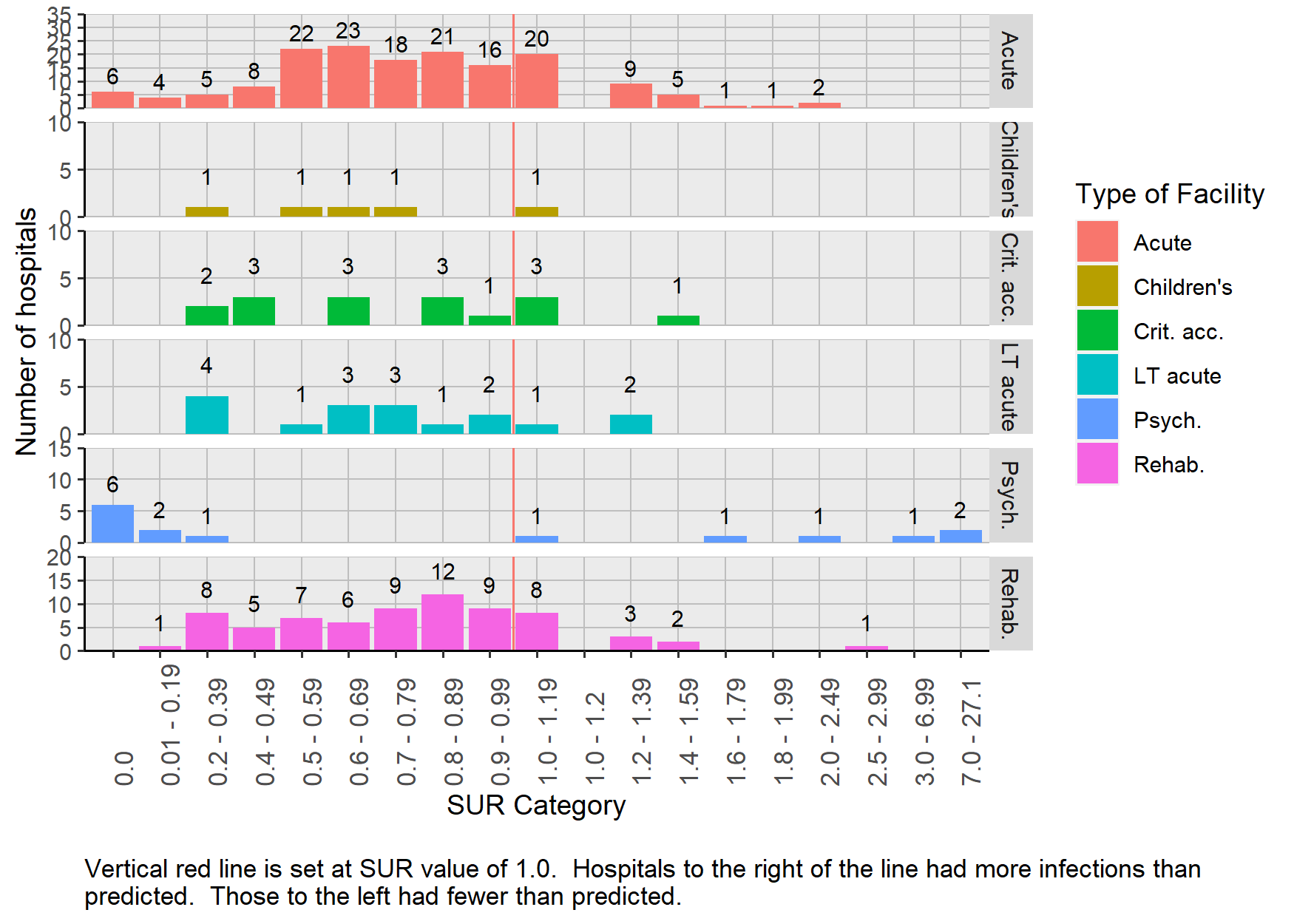
Figure 2 shows that the hospital-specific urinary catheter SUR values were dispersed and ranged from 0 to 27.12. Two hundred nineteen (76.8%) of the 285 hospitals had SURs less than 1.0. Three psychiatric hospitals had SURs more than 3.0 (SUR: 3.3, 7.5 and 27.1), meaning that urinary catheters were used at least three times more often than those of similar hospitals from the 2015 national baseline.
Figure 2: Distribution of Urinary Catheter SURs by Hospital Type | Pennsylvania 2019 and 2018-2019
4.2.2 Hospital List
Table 5 shows the actual and predicted number of urinary catheter days, SUR values and 95% confidence intervals for each hospital. The number of predicted urinary catheter days in hospitals ranged from 0 to 53,921, and the observed use ranged from 0 to 55,116. Examination of the hospitals with the highest 10 SUR values shows that eight had less than 2,000 predicted urinary catheter days.
Table 5: List of Hospitals with Urinary Catheter SURs by Hospital Name | Pennsylvania 2019 and 2018-2019
Hospitals printed in red have statistically significantly more urinary catheter days than predicted. Hospitals printed in blue have statistically significantly fewer urinary catheter days than predicted.
4.3 CLABSI
4.3.1 SIR
In 2019, 996 CLABSIs were reported from 280 hospitals. Statistically, the state SIR value is significantly lower than the 2015 national baseline (SIR: 0.7; 95% CI: (0.66, 0.74)). The number of reported CLABSIs in 2019 is 433 fewer CLABSIs than predicted using the 2015 national baseline data and 48 fewer than were reported in 2018. To reach the 2020 HHS goal of a 50% reduction in CLABSIs, an additional 282 infections need to be prevented throughout the commonwealth.
Of the 10 hospitals with the greatest number of predicted infections seven had a lower statistically significant SIR than the 2015 national baseline. The SIR values from three other hospitals were not statistically significantly different from the 2015 national baseline data. Together these three hospitals had 261 CLABSIs. This is 26% of all CLABSIs in the state and yet only 17% of the number predicted infections in the state are predicted to come from these hospitals. Cumulatively, these three hospitals had 29 more CLABSIs than in 2018. Collectively, these three hospitals need to prevent 140 infections to reach HHS goal.
4.3.2 Hospital Type
As seen below in Table 6, the majority of CLABSIs were reported in ACHs (785 of 996). Overall, the ACHs perform 32% better than hospitals from the 2015 national baseline (SIR: 0.68, 95% CI: (0.63, 0.73)). Long term acute care hospitals have a nearly identical statistically significant SIR (SIR: 0.67, 95% CI: (0.53, 0.84)) as ACHs. Inpatient rehabilitation facilities also had a nearly identical SIR (SIR: 0.69, 95% CI: (0.41, 1.10)), but it is not statistically different from 1.0. No CLABSIs were reported from psychiatric hospitals and 1 is predicted. Children’s hospitals have 12% fewer CLABSIs than predicted from the 2015 national baseline. Critical access hospitals on the other hand, have 1 more CLABSI than predicted from the 2015 national baseline, but this is not statistically significant from the 2015 national baseline (SIR: 1.49, 95% CI: (0.25, 4.92)).
Table 6: Summary of CLABSI Measures Stratified by Hospital Type | Pennsylvania, 2019
4.3.3 Distribution
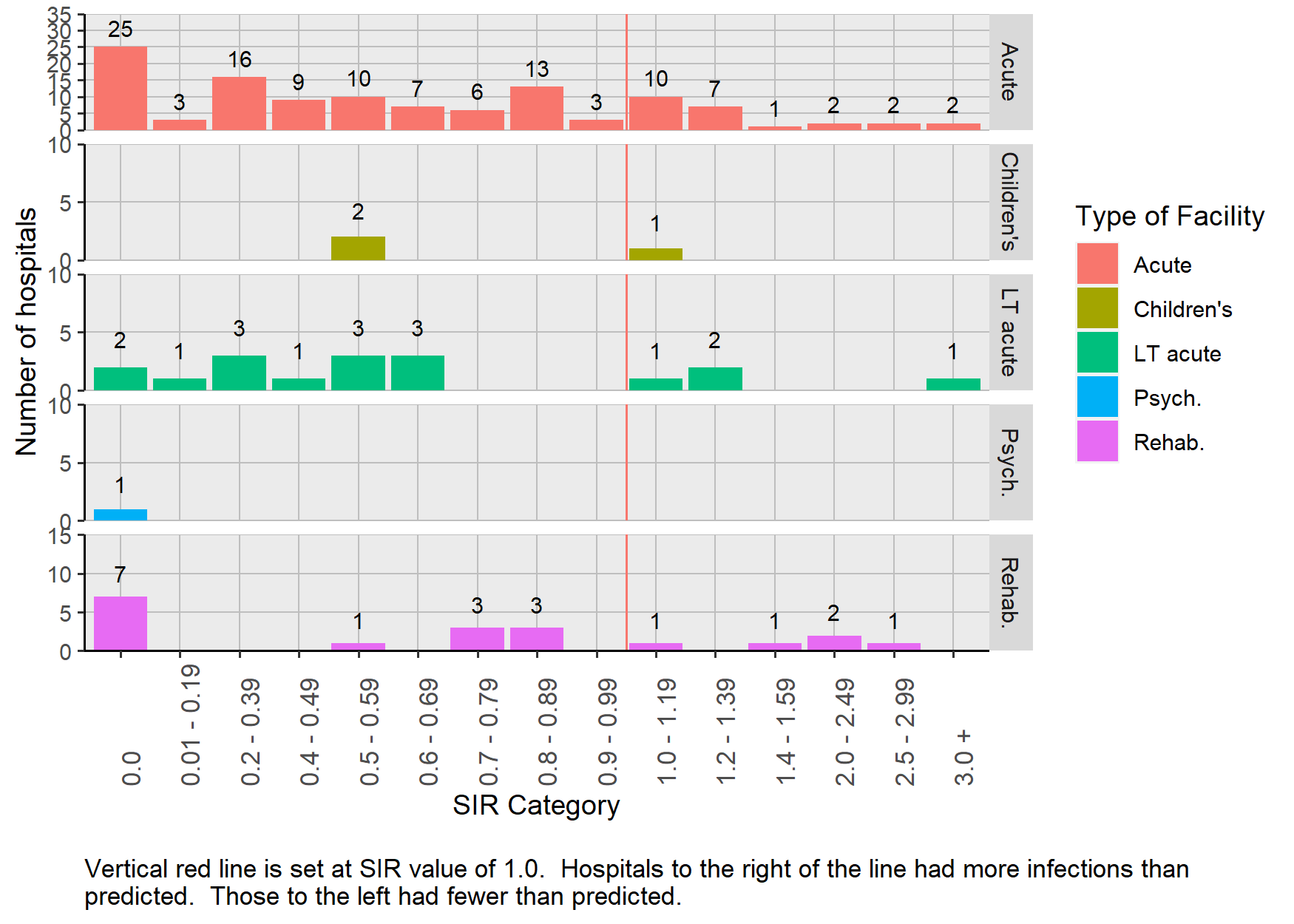
Figure 3 displays the distribution of hospital specific CLABSI SIR values (N=156) grouped by hospital type. This includes 132 hospitals in which a SIR was calculated with 2019 data and 24 hospitals with 2018 and 2019 data combined. Despite the inclusion of two years of surveillance data, 124 (44.3%) hospitals had less than one predicted infection and relatively few central lines days (maximum = 2,242). CLABSIs were reported from 21 (16.9%) of those hospitals, and SIR values were not calculated because the number of predicted infections was less than 1.0. Hospital specific SIR values were not calculated for CAHs because the number of predicted CLABSIs was less than 1.0.
Figure 3: Distribution of CLABSI SIRs by Hospital Type | Pennsylvania 2018-2019 and 2019
4.3.4 Hospital List
Table 7 lists CLABSI data, as well as county location of hospital and year(s) from which the data were based from 280 hospitals. Thirty-three hospitals (identified by blue font) had statistically significantly fewer CLABSIs than were predicted in the 2015 national baseline, meaning that their SIR was less than 1.0. Seven of these hospitals reported no infections, although the predicted number of infections ranged between 3.2 and 7.1. Among the remaining 26 hospitals where at least one CLABSI was reported, the range of predicted CLABSIs was 5.3 to 86.9. Four hospitals (identified by red font) had statistically significant more CLABSIs than were predicted in the 2015 national baseline, meaning that their SIR was more than 1.0. All of these hospitals had less than five predicted CLABSIs.
Table 7: List of Hospitals with CLABSI SIRs and Associated Measures | Pennsylvania 2018-2019 and 2019
Hospitals printed in red have statistically significantly more CLABSIs than predicted. Hospitals printed in blue have statistically significantly fewer CLABSIs than predicted.
4.4 Central Line SUR
The central line SUR was calculated for all the facilities that reported data. The state SUR was 0.8 (95%CI: (0.80, 0.80)) which is 19.8% less use than predicted by the 2015 national baseline. In 2018 the SUR was 0.84 (95% CI: (0.84, 0.84)).
Seventeen hospitals reported no central line days, 52 hospitals reported between 1 and 200 central line days, 63 reported between 201 and 1,000 central line days, 92 reported between 1,001 and 5,000 central line days, 28 hospitals reported between 5,001 and 10,000 central line days, and the remaining 28 reported more than 10,000 central line days.
4.4.1 Hospital Type
Table 8 lists reported and predicted central line days and SURs stratified by hospital type. Central lines were rarely used in psychiatric hospitals and CAHs because patients in those facilities typically do not present with medical conditions that require monitoring with a central line or these patients are transferred to an acute care hospital after placement of a central line. Central line catheters were most frequently used in ACHs (N = 1,115,526 days.)
Table 8 lists summary statistics regarding central line use in different types of hospitals. Critical access and psychiatric hospitals in Pennsylvania, as a group, use central lines 13% and 53% statistically significantly more often than similar hospitals from the 2015 national baseline (SUR: 1.13, 95% CI: (1.10, 1.16) and SUR: 1.53, 95% CI: (1.45, 1.61) respectively). Children’s hospitals were using central lines only slightly less often than similar hospitals from the 2015 national baseline (SUR:0.96, 95% CI: (0.95, 0.96)). Long term acute care, acute care and inpatient rehabilitation facilities use central lines less than similar hospitals from the 2015 national baseline.
Table 8: Central line SURs by Hospital Type | Pennsylvania, 2019
4.4.2 Distribution
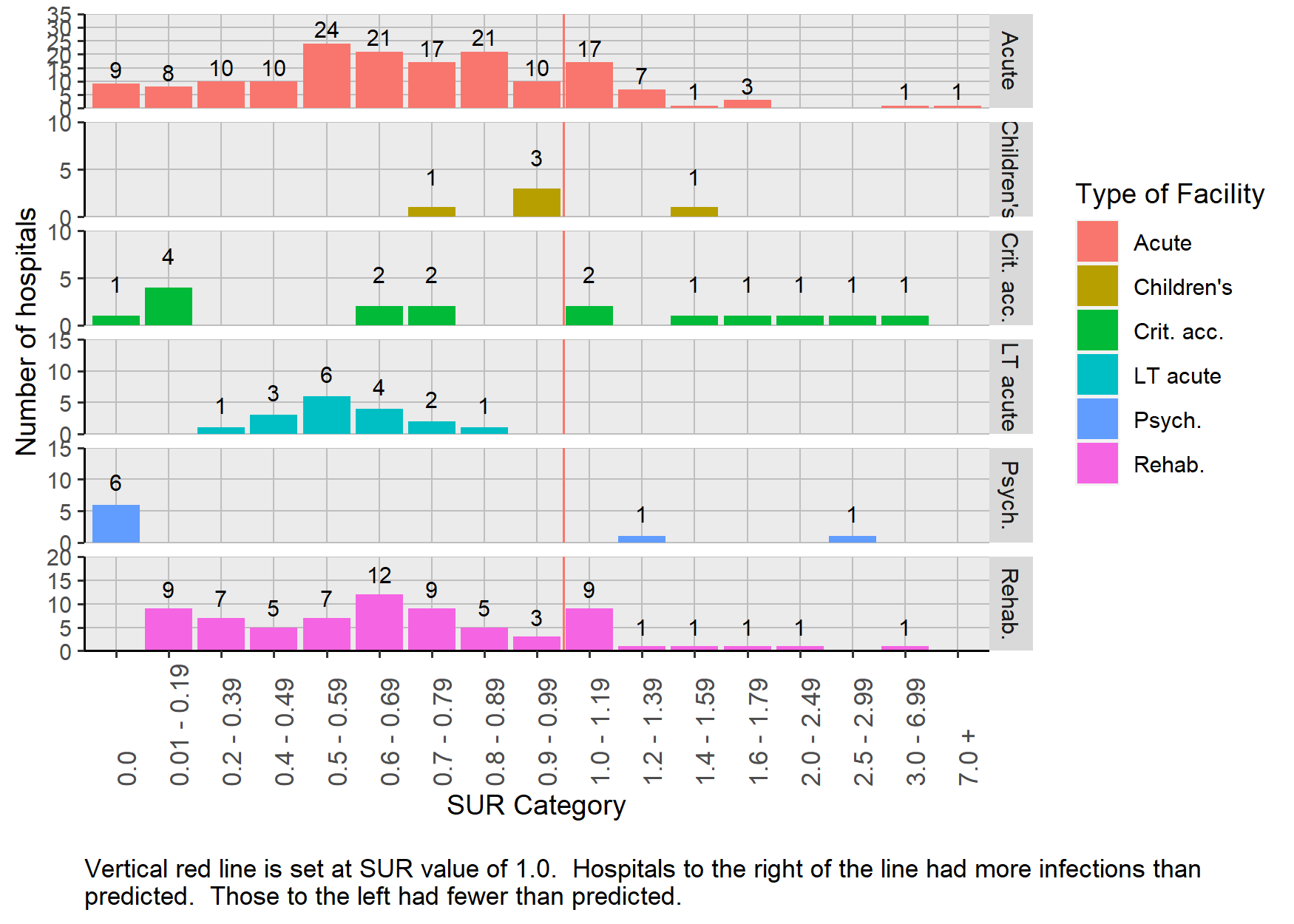
Figure 4 shows that the hospital-specific central line SUR values were dispersed and ranged from 0 to 17.4. Two hundred twenty-three (75.8%) of the 277 hospitals with more than 1 predicted central line day had a SUR value less than 1.0. Eight hospitals had SUR values more than 2.0 but they reported no CLABSIs.
Figure 4: Distribution of Central Line SURs by Hospital Type | Pennsylvania 2019
4.4.3 Hospital List
Table 9 shows that the number of predicted central line days in hospitals ranged from 0 to 73,139, and the observed use ranged from 0 to 86,038. Examination of the hospitals with the highest 10 SURs shows that all had less than 2,000 predicted central line days.
Table 9: List of Hospitals with Central Line SURs by Hospital Name | Pennsylvania 2018-2019 and 2019
Hospitals printed in red have statistically significantly more central line days than predicted. Hospitals printed in blue have statistically significantly fewer central line days than predicted.
4.5 SSIs
4.5.1 Description of Surgical Procedures
This 2019 report includes HAIs that were reported following seven surgical procedure types: three types of cardiac surgery, hip and knee replacements, abdominal hysterectomy, and colon surgery. After applying the exclusion criteria, a total of 118,368 surgical procedures were performed and followed for signs of a surgical site infection (SSI) in 165 hospitals during 2019. As a reminder, patients who had surgical procedures but did not spend the night in the hospital were excluded because this type of procedure was classified as an outpatient procedure, not an inpatient procedure.
Table 10 shows that 56 hospitals perform all seven surgeries. Table 11 shows the number of surgeries that were performed at each hospital for each surgical procedure type in 2019.
Table 10: SSI SIRs for each of Seven Procedures | Pennsylvania, 2019
| Number of Hospitals | Knee Replacement | Hip Replacement | Abdominal Hysterectomy | Colon | Cardiac Surgery | CBG Surgery 1 incision | CBG Surgery 2 incisions |
|---|---|---|---|---|---|---|---|
| 59 | X | X | X | X | |||
| 56 | X | X | X | X | X | X | X |
| 18 | X | X | X | ||||
| 8 | X | X | X | X | X | ||
| 6 | X | X | |||||
| 4 | X | X | X | ||||
| 3 | X | ||||||
| 3 | X | X | |||||
| 2 | X | ||||||
| 2 | X | X | |||||
| 1 | X | X | |||||
| 1 | X | ||||||
| 1 | X | X | X | ||||
| 1 | X | X | X | X |
Table 11: Number of surgeries performed at each hospital | Pennsylvania, 2019
4.5.2 SIRs
As mentioned in the Methods chapter of this report, the NHSN protocol sets forth two different methods to evaluate SSIs, which are referred to as “all” and “complex”. Results presented in this section contain metrics using the “complex” model, which includes only deep tissue and organ space SSIs. (SSI results that use the “all” model are presented in Appendix A.) Superficial infections are not counted as cases in the “complex” model. For a more detailed description of the complex model, please refer to the SIR Guide Supplement46.
4.5.3 State SSI SIRs
Table 12 shows the number of surgeries performed in 2019, number of SSIs, number of predicted infections and respective SIR values for each surgical procedure. Knee replacement surgeries are the most commonly performed surgeries reported in NHSN with 42,316 performed during 2019. CBG with two incisions and CBG with one incision were only performed in acute care hospitals.
The SSI SIR values for the seven monitored surgical procedures range between 0.23 and 1.03. The state-wide SSI SIR values for colon surgeries, CBG with 2 incisions and CBG with 1 incision are statistically significantly lower than the 2015 national baseline (Colon: SIR: 0.79, 95% CI: (0.71, 0.88), CBG with 2 incisions SIR: 0.73, 95% CI: (0.54, 0.97), CBG with 1 incisions SIR: 0.23, 95% CI: (0.04, 0.75)).The SIR values for knee and hip replacement are close to 1.0 (SIR: 0.95 and SIR: 1.03 respectively) and not statistically different than the 2015 national baseline. The SIR values for abdominal hysterectomies and cardiac procedures are about 15% less than the number predicted by the 2015 national baseline (SIR: 0.86 and SIR: 0.84 respectively) but not statistically different than the 2015 national baseline.
To reach the 2020 HHS goal of a 30% reduction (SIR = 0.70) in colon SSIs, an additional 38 colon SSIs need to be prevented. To reach the same goal in abdominal hysterectomy SSIs, an additional 15 infections need to be prevented.
Table 12: SSI SIR Values for each of seven procedures | Pennsylvania, 2019
4.5.4 Hospital Type
Because nearly all surgical procedures were performed in acute care hospitals, calculation of 2019 SSI SIR values stratified by hospital type is limited. Only cardiac and colon surgeries performed in children’s hospitals had more than one predicted SSI. These are presented in Table 13. Neither of the surgeries had statistically significant SIR values that differed from the 2015 national baseline, although they both had SIR values less than 1.0 (Colon SIR: 0.52, Cardiac SIR: 0.33).
Table 13: SIRs from Surgical-Procedure Combinations Commonly Performed in Specific Hospital Types | Pennsylvania, 2019
4.5.5 Distribution
The distribution of 2019 and 2018-2019 SIR values for the seven surgery types is presented in Figure 5. Because the SIR was calculated in those hospitals in which the predicted number of infections was 1.0 or more for either timeframe, 395 hospital-procedure pairs are included. This includes only four hospital surgery pairs from children’s hospitals and one from CAHs. The remaining SIR values are from ACHs. Forty (10.1%) of the SIR values were 2.0 or larger.
Figure 5: Distribution of SIRs Stratified by Surgical Procedure Type| Pennsylvania, 2018-2019 and 2019

4.5.6 Statistically Significant SSI SIRs
Table 14 shows the number of hospitals with statistically significant SSIs when using data from 2019 and 2018-2019. Of the four surgical procedures shown in the table, more hospitals that performed cardiac, knee replacement and hip replacement had statistically significantly high SIR values than statistically significantly low SIR values. Among hospitals that performed colon surgical procedures, three hospitals have a statistically significant SIR value less than 1.0 and three hospitals have a statistically significant SIR value more than 1.0.
Table 14: Number of hospitals with statistically significant SSI SIRs | Pennsylvania, 2018-2019 and 2019
4.5.7 Hospital List
Table 15 displays the comprehensive list of all hospital-surgical procedure pairs in which one or more of the surgeries was performed during 2019 (N= 771). The SIR was calculated for 260 hospital-surgery pairs (33.7% of 771) when the predicted number of infections was more than 1.0 in 2019. An additional 135 SIR values (17.5%) could be calculated when 2018 and 2019 data were combined. The remaining 376 hospital surgery pairs (48.8%) had less than 1.0 predicted infections and a SIR could not be calculated. One hundred (26.6%) of those pairs had one or more SSIs were reported even though less than 1.0 was predicted.
Table 15: Hospitals that Perform Seven Types of Surgeries and their SSI SIRs and Associated Measures | Pennsylvania, 2018-2019 and 2019
Hospitals printed in red have statistically significantly more SSIs than predicted. Hospitals printed in blue have statistically significantly fewer SSIs than predicted.
4.6 C. difficile Infections
CDI LabID events are the most common type of HAI reported in this report. All patients admitted to a hospital are at risk to get a CDI and each day in the hospital increases the chance of getting a CDI28. In 2019, 2,853 CDI events occurred, and 4,426 were predicted from the 2015 national baseline. This is 26.1% (N = 1,008) fewer than in were reported in 2018 . The state CDI SIR is 0.64 (95% CI: (0.62, 0.67)), which means that the number of CDI cases is 35.5% lower than the number predicted by the 2015 national baseline. Collectively, the state reached the 2020 HHS goal of attaining a 30% reduction (SIR = 0.70) in CDI events.
All 10 of the hospitals with the largest predicted number of CDIs have SIR values that are statistically significantly less than 1.0 but only four have a SIR value that meets the HHS goal. Collectively, these 10 facilities reported 338 less CDI events than were reported in 2018 although one had more CDI events in 2019 than were reported in 2018.
4.6.1 Hospital Type
As shown in Table 16, most (2,598 of 2,853) CDI events occurred in acute care hospitals and the SIR was 0.65 (95%CI: (0.62, 0.67)). This means that CDI events in 2019 occur 35% less than similar hospitals in the 2015 national baseline. Departmental guidance states that children’s, CAH and psychiatric hospitals are not required to report LabID events. The data reported here do not reflect CDI events from those facilities. The SIR in LTAC hospitals was 0.54 (95% CI:(0.43, 0.68)). LTACs had 65 fewer CDI events than predicted by the 2015 national baseline and 57 less than were reported in 2018. The SIR in IRFs was 0.64 (95% CI:(0.55, 0.74)). IRFs had 101 fewer CDI events than predicted by the 2015 national baseline and 16 less than were reported in 2018.
Table 16: C. difficile Infection Event SIRs by Hospital Type | Pennsylvania, 2019
4.6.2 Distribution
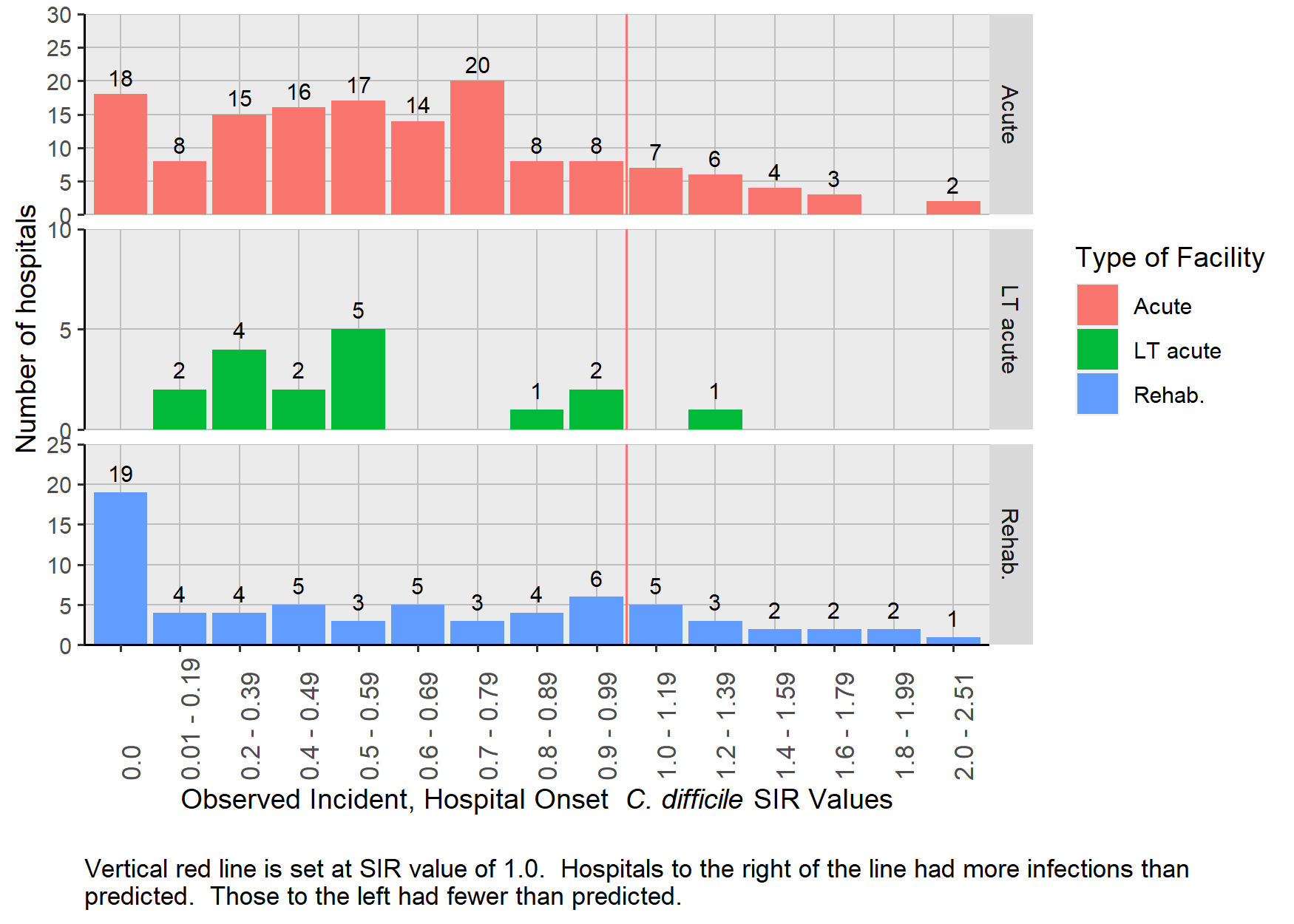
Figure 6 shows the distribution of CDI SIR values for ACH, LTAC hospitals, and IRFs among hospitals with a SIR. This figure includes 211 hospitals in which a SIR was calculated using 2019 data and 20 hospitals with 2018 and 2019 data combined. Only 17 (6.9%) hospitals have less than 1.0 predicted infection. Four CDI events were reported from those hospitals and 10.5 were predicted.
The SIR values among the 231 hospitals ranged from 0 to 2.51 The distribution among the 146 ACHs show that most SIR values (N = 124, 84.9%) are less than 1.0. Two ACHs and one IRF have SIR values more than 2.0. All but one LTAC hospital have a SIR value less than 1.0 (N = 15, 88.2%). Seventy-six percent (N=52) of IRFs have a SIR value less than 1.0.
Figure 6: Distribution of C. difficile SIRs Stratified by Hospital Type| Pennsylvania, 2018-2019 and 2019
4.6.3 Hospital List
Table 17 shows the number of patients at risk for CDI, number of CDI events and SIR for each Pennsylvania hospital that reported data (N=248). The display of CDI test type used by hospitals in 2019 is included in this table as a courtesy for facilities to evaluate CDI test methods used by their peers. The statistical models adjust for type of CDI test that was performed for each quarter of the year. The CDI test is not a factor that can explain differences between SIR values.
Thirty-seven hospitals had a SIR of 0.0, even though the number of predicted CDI events ranged between 1.0 and 12.8. Seventy-seven hospitals (identified by blue font) had statistically significant SIR values that were less than 1.0, meaning that they had fewer CDI events than predicted by the 2015 national baseline. Seven of these hospitals had no CDI events, although the predicted number ranged between 4 and 12.8. Among the remaining 70 hospitals where at least one CDI event was reported, the range of predicted CDIs was between five and 158.6. Three hospitals had statistically significant elevated SIR values, meaning that more CDI events were reported than predicted during the 2015 national baseline. The SIR values ranged between 1.6 and 2.51.
Table 17: List of Hospitals with C. difficile Infection Event SIRs by Hospital Name | Pennsylvania 2018-2019 and 2019
Hospitals printed in red have statistically significantly more CDI events than predicted. Hospitals printed in blue have statistically significantly fewer CDI events than predicted.
4.7 MRSA Blood Infections
In 2019, 343 MRSA bloodstream events were reported and 492.8 were predicted from the 2015 national baseline. The state MRSA SIR is 0.7 (95% CI:(0.62, 0.77)). Departmental guidance states that children’s, CAHs, and psychiatric hospitals are not required to report MRSA blood LabID events. The data reported here do not include MRSA bloodstream events from those facilities. To reach the 2020 HHS SIR goal of 0.50, an additional 97 MRSA bloodstream events need to be prevented.
Of the 10 hospitals with the greatest number of predicted infections only one had a lower statistically significant SIR than the 2015 national baseline. The SIR values from the nine other hospitals were not statistically significantly different from the 2015 national baseline data. Together these nine hospitals had 112 MRSA events. This is 33% of all MRSA events in the state and yet only 28% of the number predicted infections in the whole state were predicted to come from these hospitals. Cumulatively, these nine hospitals reported 23 more MRSA events in 2019 than were reported in 2018. Collectively, these hospitals need to prevent 43 infections to reach the 2020 HHS goal (SIR = 0.50).
4.7.1 Hospital Type
Table 18 lists patient days at risk, number of predicted and observed MRSA LabID events, and the SIR values for ACH, LTAC hospitals, and IRFs. ACHs had statistically significantly fewer MRSA LabID events than predicted (SIR: 0.72, 95% CI: (0.64, 0.80)). LTAC hospitals reported 70% fewer MRSA LabID events than predicted by the 2015 national baseline. The SIR reached statistically significance (SIR: 0.3, 95% CI: (0.13, 0.59)). IRFs also had fewer MRSA LabID events than predicted by the 2015 national baseline (N = 4) but this didn’t reach statistical significance (SIR: 0.66, 95% CI: (0.31, 1.26)).
Table 18: MRSA Blood Infections SIRs by Hospital Type | Pennsylvania, 2019
4.7.2 Distribution
Figure 7 shows the distribution of MRSA LabID SIR values for ACHs, LTAC hospitals, and IRFs. This figure includes 98 hospitals in which a SIR was calculated with 2019 data and 28 hospitals with 2018 and 2019 data combined. Despite the inclusion of two years of surveillance data, 122 (49.2%) hospitals have less than 1.0 predicted infection. Twenty-five MRSA bloodstream infection events were reported from 25 of those hospitals but 39.9 were predicted.
The SIR values among 126 hospitals shown in Figure 7 range from 0.0 to 2.89. The distribution among the ACH shows that most SIR values (N= 84, 78.5%) are less than 1.0.
Figure 7: Distribution of MRSA Blood Infection SIRs Stratified by Hospital Type| Pennsylvania, 2018-2019 and 2019

4.7.3 Hospital List
Table 19 includes data from 248 hospitals. Thirty-seven hospitals had a SIR of 0.0. The number of predicted MRSA LabID events ranged between 1 and 8.2 in those facilities. Eight hospitals (identified by blue font) had statistically significant SIR values that were less than 1.0, meaning that they had fewer MRSA events than in the 2015 national baseline. Three of these hospitals had no MRSA LabID events. No hospitals had statistically significant SIR values more than 1.0.
Table 19: List of Hospitals with MRSA Blood Infection SIRs by Hospital Name | Pennsylvania 2019
Hospitals printed in red have statistically significantly more MRSA events than predicted. Hospitals printed in blue have statistically significantly fewer MRSA events than predicted.