6 Appendix
6.0.1 SSI SIRs (Superficial and Deep Tissue)
As mentioned in the Methods chapter of this report, the NHSN protocol sets forth two different methods to evaluate SSIs, which are referred to as “all” and “complex”. Results presented in this section contain metrics using the “all” model, which includes superficial infections, deep tissue and organ space SSIs. For a more detailed description of the all case definition and adjustment models, please refer to the SIR Guide Supplement48. HHS does not set a 2020 reduction goal for this classification of SSIs
6.0.2 State SSI SIRs by Type of Surgical Procedure
Table A.1 shows the number of surgeries performed in 2020, number of SSIs, number of predicted infections and respective SIR values for each surgical procedure. Note that the number of predicted surgeries performed is slightly different than those displayed in Chapter 4, Table 14 but the number of surgeries performed is identical. The state SSI SIR values for the seven benchmarked surgical procedures ranged between 0.59 and 1.38. The HPRO SSI SIR value was close to 1.0 (SIR: 0.92; 95% CI: (0.81, 1.04)). The CBGC SSI SIR value was more than 1.0 (SIR: 1.38) but are not statistically different than the 2015 national baseline. The CARD and CBGB SSI SIR values were about 15% below the number of predicted infections, (CARD SIR: 0.85, CBGB SIR: 0.86) but neither was statistically significantly different than 1.0. The state-wide SSI SIR values for COLO, KPRO and HYST were statistically significantly lower than the 2015 national baseline (COLO SIR: 0.64; 95% CI: (0.59, 0.70), KPRO SIR: 0.77; 95% CI: (0.66, 0.89), HYST SIR: 0.59; 95% CI: (0.49, 0.71)).
Table A.1: SSI SIRs for each of Seven Procedures | Pennsylvania, 2020
6.0.3 SSI Measures by Type of Hospital
Because nearly all surgical procedures were performed in ACHs, calculation of 2020 SSI SIR values stratified by hospital type is limited. Five surgical procedure-hospital pairs had more than one predicted SSIs and these are presented in Table A.3 below.
None of the SIR values in Table A.2 were statistically significantly different from the 2015 national baseline. In CAHs that performed HPRO, one more SSI than was predicted was reported (SIR: 1.81). The SIR values from the other surgical-hospital type pairs were less than one. SSIs reported from CAHs that performed COLO and KPRO were identical to the number predicted, while SSIs reported from children’s hospitals that performed CARD and COLO were slightly more than half of the predicted number.
Table A.2: SIRs from Surgical-Procedure Combinations Commonly Performed in Specific Hospital Types | Pennsylvania, 2020
6.0.4 Distribution of SSI SIR Values by Type of Surgery
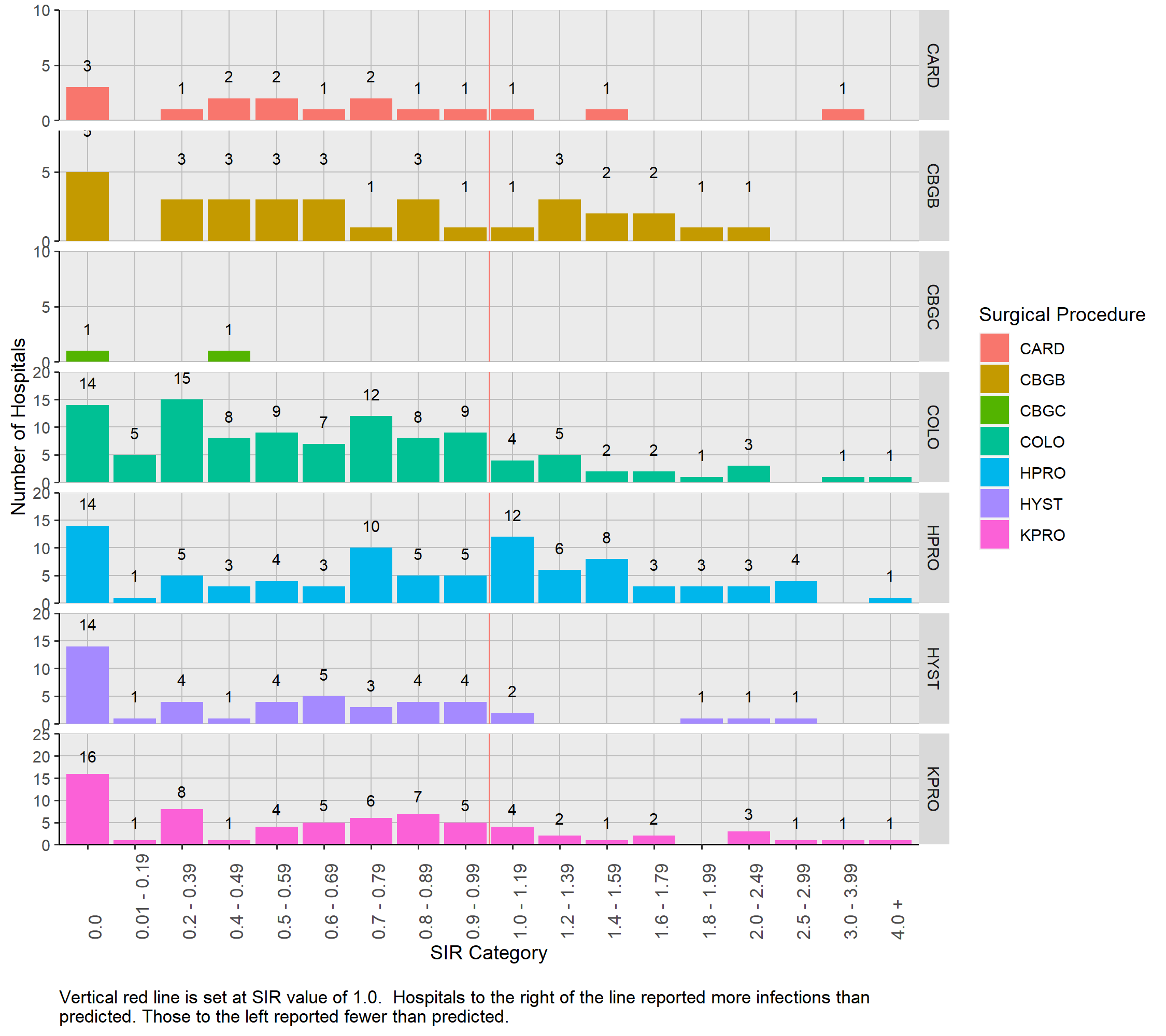
The distribution of 2020 SIR values for the seven surgery types is presented in Figure A.1. The SIR was calculated in those hospitals in which the predicted number of infections was 1.0 or more resulting in the inclusion of 359 hospital-procedure pairs.
This includes only four hospital-procedure pairs from children’s hospitals. The remaining SIR values are from acute care hospitals. Twenty-three (6.4%) of the SIR values were 2.0 or larger.
Figure A.1: Distribution of SSI SIRs Stratified by Surgical Procedure Type| Pennsylvania, 2020
6.0.5 Statistically Significant SIRs by Surgery Type
Table A.4 shows the number of hospitals with statistically significant SSI SIR values for each type of surgical procedure. It is noteworthy that hospitals that performed COLO had a statistically significantly lower SIR value compared with the 2015 national benchmark.
Table A.4: Number of Hospitals with Statistically Significant SSI SIRs | Pennsylvania, 2020
6.0.6 SSI Measures by Hospital
Table A.5 displays the comprehensive list of all hospitals in which one or more of the seven surgeries was performed (N= 753) along with the number of reported and predicted number of SSIs. The SIR was calculated for 359 hospital-surgery pairs (47.7% of 753) when the predicted number of infections was more than 1.0.
Table A.5: Hospitals that Perform Seven Types of Surgeries and their SSI SIRs and Associated Measures | Pennsylvania, 2020
Hospitals printed in red reported statistically significantly more SSIs than predicted. Hospitals printed in blue reported statistically significantly fewer SSIs than predicted.